
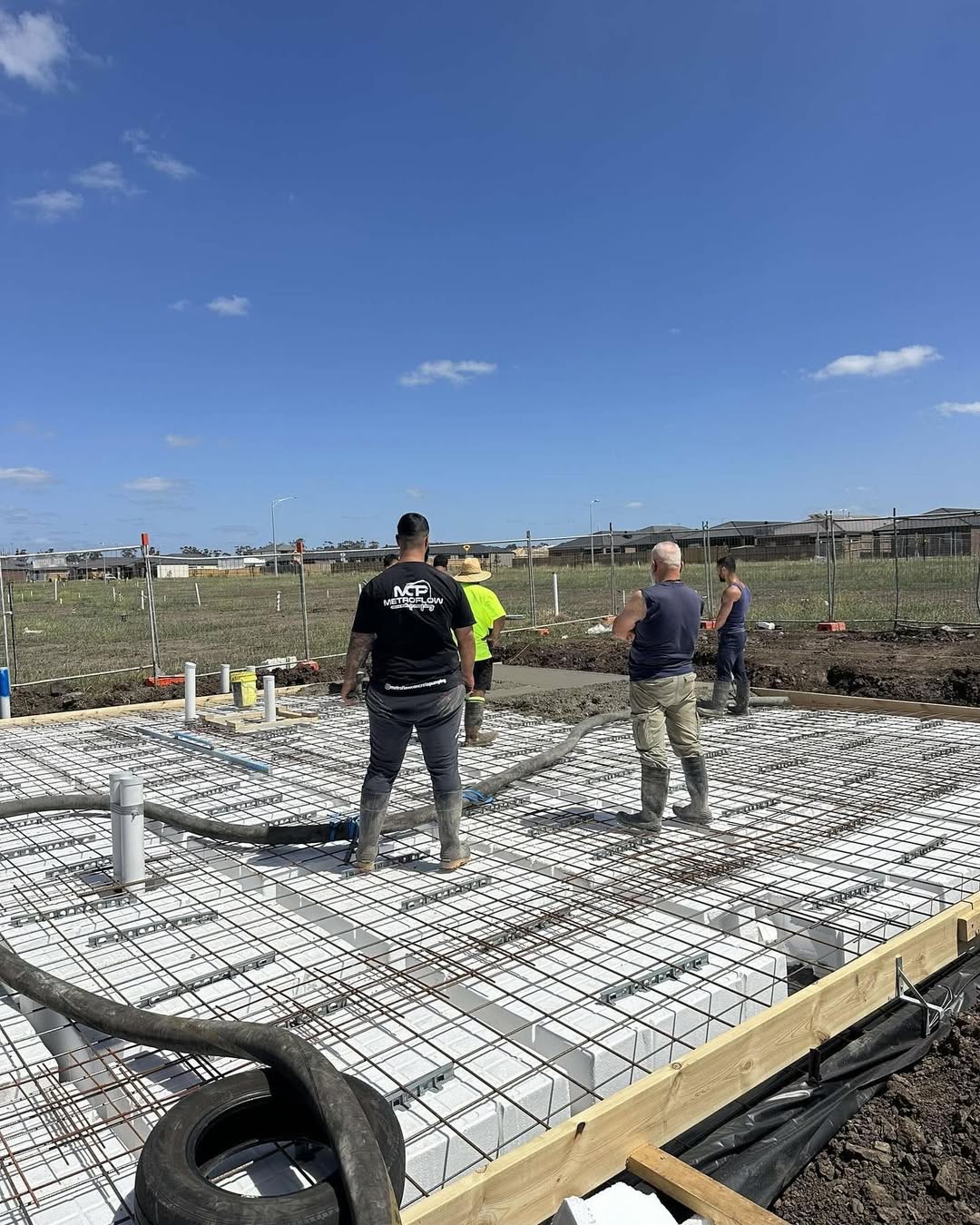
Basement construction boomed across Melbourne — double-storey homes on small lots, apartment podiums, townhouse developments with parking below grade. Concrete must descend into excavations — walls, raft slabs, and suspended basement decks — while agitator trucks stay at street level. That geometry defines everything: line down ramp, pump stand position, hopper feed from above, and excavation safety while hose and crew work below ground.
Typical pumping configurations
- Line pump at street, pipeline down ramp — most common on infill basements. Hose routed along approved ramp path; pump at top or mid-level depending on feed geometry.
- Pump in excavation — rare; only with stable shoring, engineer approval, and egress for operator — usually short-duration wall pours with planned egress.
- Boom into excavation — when street parking allows reach over shoring into wall forms — limited on tight lots; see boom access.
Feed and suction issues below grade
Trucks at street, pump below — classic chute and feed challenge. Long vertical chute drops or intermediate hopper transfer needed. Intake management critical; operators coordinate drum discharge with pump strokes so hopper neither overflows nor starves.
Line routing in excavations
Hose secured along ramp, not loose on slope — trip and runaway risk. Bends at ramp toe carefully planned — high pressure point. Segregation on steep vertical segments managed with mix design and rate — often slightly higher paste mixes approved by engineer.
Shoring and surcharge
Pipeline weight and personnel load on shoring — engineer's problem, but pump company needs clearance to enter excavation. Outriggers on adjacent street still affect surcharge on deep cuts — link to ground bearing on boundary.
Waterproofing and finish sensitivity
Basement walls often tie into tanking systems — cold joints and honeycomb are waterproofing failures. Steady pump feed helps wall placement; rich wall mixes common. Vibration-free SCC in some commercial basements — see SCC guide.
Volumes and scheduling
Basement walls pour in lifts; rafts in one or two hits. Truck spacing tight on wall cycles — cold joint risk if gap too long. Scheduling discipline on multi-lift wall days.
Melbourne infill realities
Inner north and bayside — single-lane access, neighbour boundaries, no boom footprint. Line pump dominance; Metro Melbourne experience with battle-axe blocks and retained-boundary excavations.
Basements aren't exotic — they're geometry problems solved with line planning, feed discipline, and respect for excavation safety.
Raft pours in tight excavations
Basement rafts combine volume with confined hose routing around starter bars and services penetrations. Pre-pour walk tags penetration locations so hose doesn't snag mid-stroke — snag pulls reinforcement, damages waterproofing boots, stops pour.
Weather and flooded excavation
Melbourne autumn rains fill excavations overnight — pump booking holds flexibility because pumping into muddy raft edge contaminates structural zone. Pump company won't be the only party cancelling; builder pumps sump, re-inspects, reschedules.
Permanent dewatering interaction
Basements with active dewatering during raft pour change effective moisture environment — not pump issue directly but affects curing and sometimes line humidity. Operator notes water ingress at raft edge; concreter adjusts curing; dewatering continues per engineer not pump schedule.
Waterstop and penetration details at hose level need finisher access — pump pauses at penetrations standard on quality basement pours.
Frequently asked questions
- Pump in hole or at street? Usually street with line down ramp — engineer approves any in-excavation stand.
- Shoring clearance? Required before personnel and hose in excavation — not pump company alone.
- Raft vs wall order? Program-specific — often walls then raft or reverse per engineer; pump follows sequence.
- Water in excavation? Pumping postponed until engineer clears placement conditions.
Double-storey basement excavations on small lots may stack wall pours below raft — line routing protects waterproofing membrane protrusions; operator walks route with waterproofer before first stroke near membrane zone.
Retaining wall pours adjacent to neighbour boundary need line routing that respects survey pegs — hose weight on uncured neighbour footings avoided; operator follows builder's boundary briefing before routing over retaining.
Temporary ramp wear from repeated line traffic between wall pours grooves soft ramp surface — ramp maintenance between pours prevents hose snag tripping handlers.
Booking with MetroFlow
Every pour starts with the same information: address or site, estimated volume, mix details if known, and photos of access from street to pour point. We respond with pump type recommendation, boom class if applicable, and all-in pricing without hidden wash or travel surprises on standard Metro jobs. On program work across Victoria, we hold rates and assign consistent operators where repeat quality matters. Whether your job is a Narre Warren house slab, a Geelong warehouse bay, or a Richmond basement wall, the physics of pumping don't change — only the geometry and mix do. Send the details through our quote form or call direct; we'd rather talk you out of the wrong pump than sell you the expensive one. Good pours are boring pours — preparation, honest communication, and operators who've seen your problem before make pour day forgettable in the best way.
Basement pour on drawings? Send ramp layout and shoring plan — we'll quote line route and feed method before excavation fills with rain.