
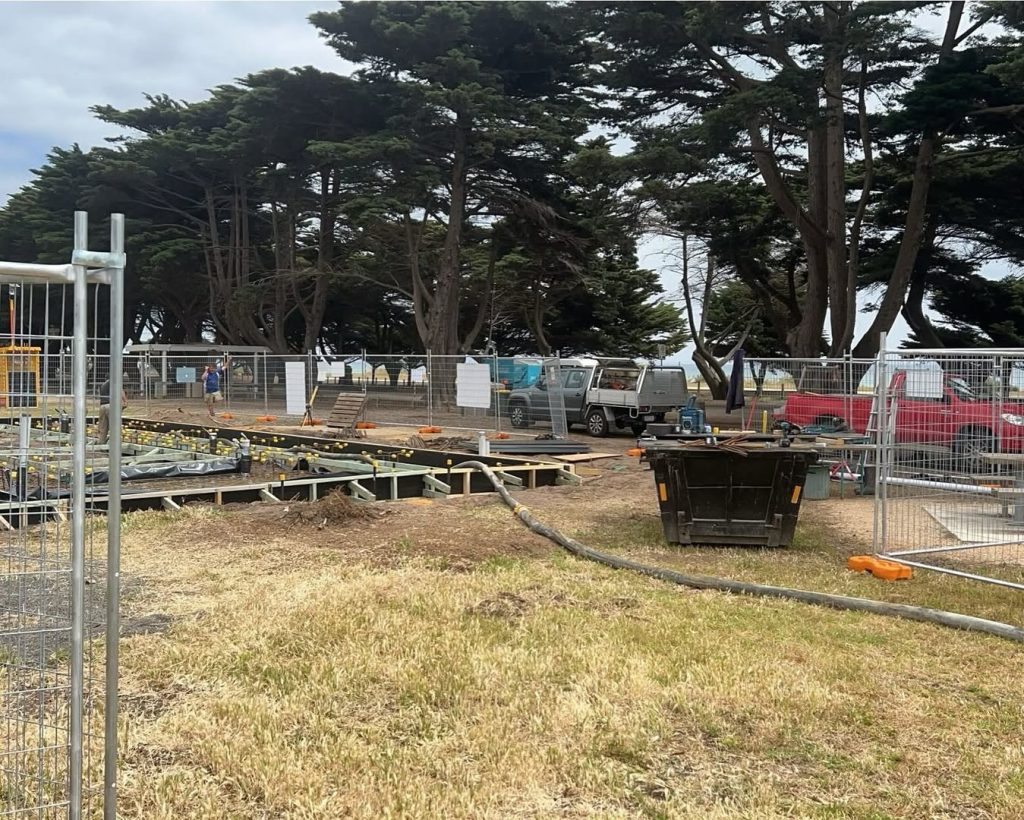
"The slab's at the back of the block — can you even reach it?" We get some version of this question every week, and the honest answer is: almost certainly yes, and from much further than most people expect. But the real number depends on physics that are worth understanding before you book, because they're also what the quote is built on.
The headline numbers
On a typical residential mix through standard line, a trailer-mounted line pump comfortably pushes concrete 50–100 metres horizontally. With planning — the right pump, the right line diameter, the right mix — runs of 150 metres and beyond are entirely achievable. Vertically, think in terms of a few storeys for residential work; every metre of height costs several metres of horizontal capability.
For context: 100 metres is the street frontage plus the full depth of four suburban blocks. The "unreachable" backyard almost never is.
What actually limits reach
A line pump generates pressure; the line and the concrete consume it. Reach runs out when friction and gravity have eaten the pressure budget. The consumers:
- Distance. Every metre of line adds friction. Simple and linear-ish — this one's easy to plan.
- Height. The expensive one. Lifting concrete costs pressure fast, which is why "60 metres flat" and "60 metres with a two-storey climb" are very different jobs. As a rough mental model, one metre up costs about the same as three to five metres along.
- Bends. Each 90° bend adds the equivalent of several metres of straight line. A route with a dozen tight corners can quietly consume a third of the budget. This is why our operators walk the route and plan sweeping bends where possible.
- Line diameter. Bigger line, less friction, more reach — but heavier to handle and more concrete wasted in the line at the end. We pick the diameter for the job.
- The mix. The biggest wildcard. A pumpable mix — decent slump, well-graded aggregate, enough fines — flows beautifully. A harsh, dry, oversized-stone mix fights the pump every metre. On long runs we talk to the batch plant about mix design before pour day, not during it.
How we plan a long run
For anything beyond a routine run, the process looks like this:
- Measure the route on satellite view, then confirm on site or with photos — including height changes and every significant bend.
- Spec the line: diameter, steel vs rubber sections (steel for the long haul, rubber for the working end), and where reducers sit.
- Check the mix with the supplier for pumpability at that distance, and agree slump at the plant.
- Plan the prime and the finish: long lines take more priming grout, and there's more concrete left in the line at the end — we account for both in the volume you order, so you're not caught short at the last corner of the pour.
All of this happens at quote stage. Long runs cost a little more in set-up time and line stock, and the quote says so plainly — what they don't cost, when planned properly, is drama.
Real jobs, real distances
Some recent examples from our own books: a shed slab 120 metres from the road on acreage outside Pakenham, pumped in one set-up with two operators walking the line. A basement garage pour in bayside Melbourne, 40 metres in and a storey down — downhill runs have their own tricks (controlling the flow, not boosting it). A pool surround in Frankston South where the line went up and over a double garage because the side access was a rock garden. None of these were exotic; they were Tuesdays.
When the answer is "boom"
Occasionally the sums genuinely favour a boom pump: big volume at height, or a run so long and lumpy that line friction makes the pour slower than the finishing crew can tolerate. That's a fair trade to weigh up — our line vs boom guide walks through it, and because we run both, the recommendation you get is the cheapest good answer, not the one that suits our fleet.
Got a "can you even reach it?" site? Send the address and a photo — we'll measure the run on satellite and give you a straight answer, usually the same day.